
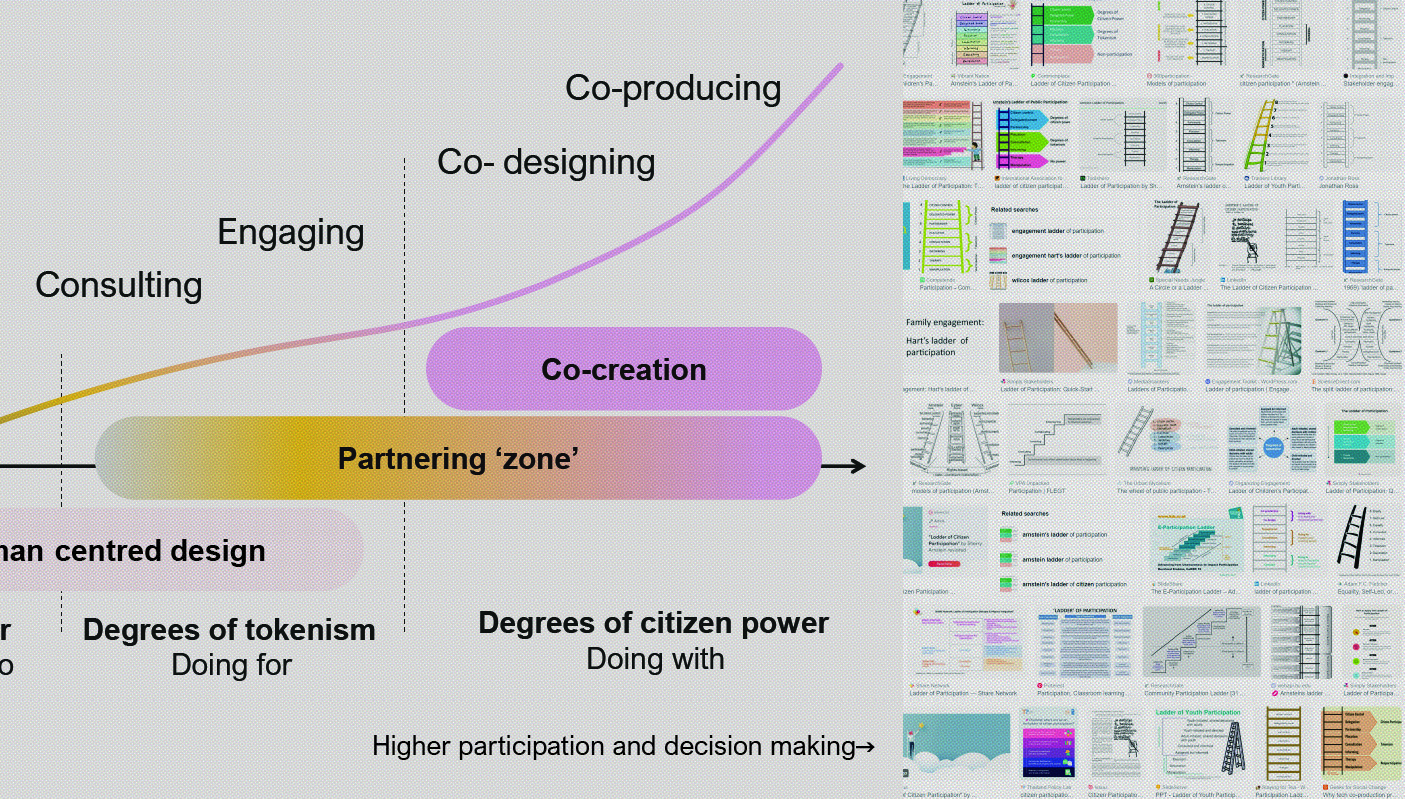
A way to describe where you sit on the participation spectrum and your goals
Currently teams and projects around the world use International Association for public participation (IAP2) spectrum of public participation to help them decide, select and define what level of participation they want to reach. Although the IAP2 Spectrum is useful, we know that in practice, public participation can vary depending on the goals and roles people play. Even if you select a point on the spectrum, it doesn’t mean you reach it.
The Gradient of Partnering is a thought starter; a way to check in with those we’ve invited about how we are partnering. How “good” or “deep” is the partnering we offer? Where do you think we fall in our partnering? What could we do to improve? Very simply, use this tool with your collaborators to know where you are, and how you could improve.
We know practically, it’s rarely just one “level” to partner with communities
We’ve created the gradient of partnering to contrast to existing spectrum’s and ladders with rungs and steps to push our practice and thinking. We propose using a gradient to describe power-sharing giving us a clear “Partnering zone” to aim for and expand while we work together with community members.


A gradient feels more accessible and realistic
For our work at Safer Care Victoria we were wanting consumer engagements fall within the “Partnering zone” all the way to co-design and co-production. This led us to create a gradient of partnering; getting away from ladders and steps.
It’s a way for us to reflect on “What range do you work in?” than a tick box of “we empowered” or “we informed” which can be limiting.
We designed this graphic for Co-design NOW (Jo Szczepanska)
Learn about the ladders of participation

- Arnstein’s Ladder of Citizen Participation Sherry Arnstein, writing in 1969 about citizen involvement in planning processes in the United States, described a “ladder of citizen participation” that showed participation ranging from high to low. Note: It includes Therapy and Manipulation as levels.
- Hart’s Ladder of Children’s Participation Sociologist Roger Hart shared his ladder of Children’s Participation in a book called Children’s Participation: The Theory And Practice Of Involving Young Citizens In Community Development And Environmental Care for UNICEF in 1997. Note: is has “Young people are decoration”
- IAP2 Spectrum of public participation In 2014 the International Association for Public Participation – shared a Spectrum of Public Participation “to assist with the selection of the level of participation that defines the public’s role in any public participation process.” Note: coercion and tokenism disappear.
- Gradient of Partnering In 2021 for the delivery of Co-design NOW Victoria’s Department of Premier and Cabinet and Safer Care Victoria cocreated the Gradient of Partnering. It symbolises the ‘Partnering zone’ we strive to reach and the fluidity of collaboration and decision making.
- An alternative ‘Ladder of Participation’ by nef was a great source of inspiration. nef is an independent think-and-do tank that inspires and demonstrates real economic well-being. In 2013, we commissioned nef (the new economics foundation) to carry out a review of existing evidence regarding co-production – examining when, why, and how it has been used in mental health and what impact it has had on people’s lives and their recovery.
Leave a Reply