
…if you don’t recognize that design can also be strategic you cannot imagine that design can play an important role in triggering, supporting and scaling-up social innovation.
Ezio Manzini
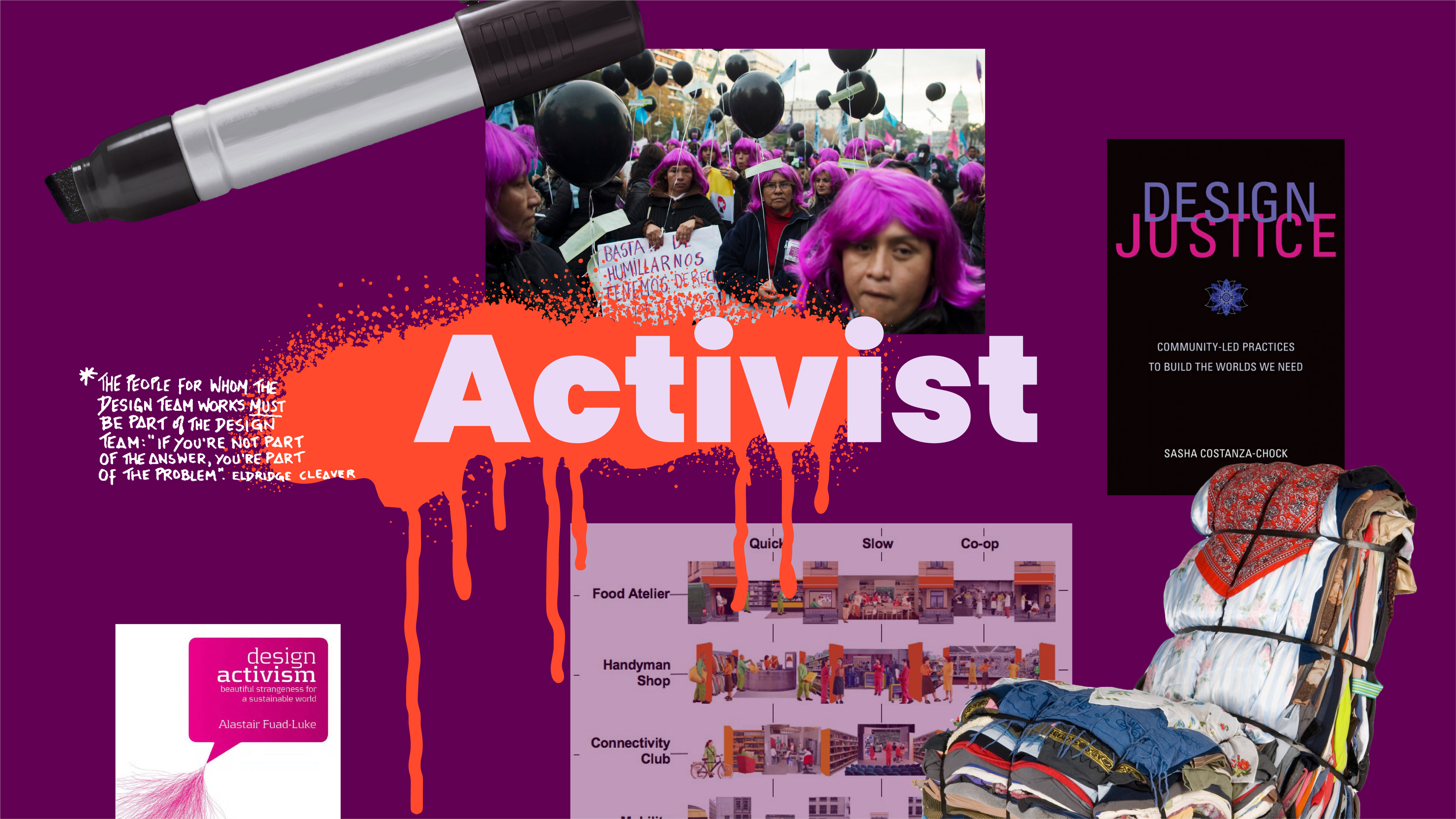
Democratising design is a political act. Co-design done well has profound impact of the system it is in. For that reason it is an approach to design activism. To define ‘Design activism’ it is a for-purpose movement that uses design to create social impact. It became official the 90’s when social design and service design first emerged from Politecnico di Milano.
“Participation emancipates people by making them active contributors rather than passive recipients. It is therefore a form of design humanism aimed at reducing domination.”
Alastair Fuad-Luke
Before that all we had as professional was eccentric gurus like Victor Papanek and Buckminister Fuller or artists like Emory Douglas.


I’m not sure if there are folks officially called ‘Design activists’ but the big names for popularising the term design activism were Ezio Manzini and Alastair Fuad-Luke. They strove to redesigning services and systems for sustainability advocating for openness, collaboration and co-design with communities to make change real.
Fuad-Luke’s Design Activism highlights how co-design is different to other practices, while Manzini’s Design, When Everybody Designs describes how to facilitate inclusion in the design process.

Picking up from that the Design Justice Network has been doing some great work in this space. Their angle? Well…
Design mediates so much of our realities and has tremendous impact on our lives, yet very few of us participate in design processes. In particular, the people who are most adversely affected by design decisions — about visual culture, new technologies, the planning of our communities, or the structure of our political and economic systems — tend to have the least influence on those decisions and how they are made.
Design Justice Network
Building on the design activism discourse that gained momentum in the 2010s, Sasha Costanza-Chock and Dori Tunstall extend the field by placing power, justice, and lived experience at the centre of design practice. Costanza-Chock’s concept of Design Justice argues that design should be led by those most affected by systems and technologies, challenging structural inequalities rather than merely mitigating their effects.
Dori Tunstall advances this activist tradition through decolonising design, highlighting how dominant design theories and practices have been shaped by colonial and Eurocentric worldviews. She calls for the restoration and privileging of Indigenous, Black, and other historically excluded ways of knowing, making cultural justice a core objective of design.
Together, their work moves design activism beyond critique toward systemic transformation. Rather than viewing designers as experts who solve problems for communities, both scholars position design as a process of collective action, redistribution of power, and the creation of more equitable futures.

Key concepts, tools and techniques: Citizen’s assemblies, Emancipatory research, Social Action skills, Power mapping, Storytelling, Theory of change, The Design Activist’s Handbook: How to Change the World (Or at Least Your Part of It) with Socially Conscious Design, Design for the Real World, Design Justice Network, Decolonising Design
📖 Read more
- Design Activism – Beautiful Strangeness for a Sustainable World by Alastair Fuad-Luke
- Sustainable Everyday – Scenarios of urban life by DESIS network with Ezio Mazini
- Design as Activism: to resist or to generate? by Ann Thorpe