
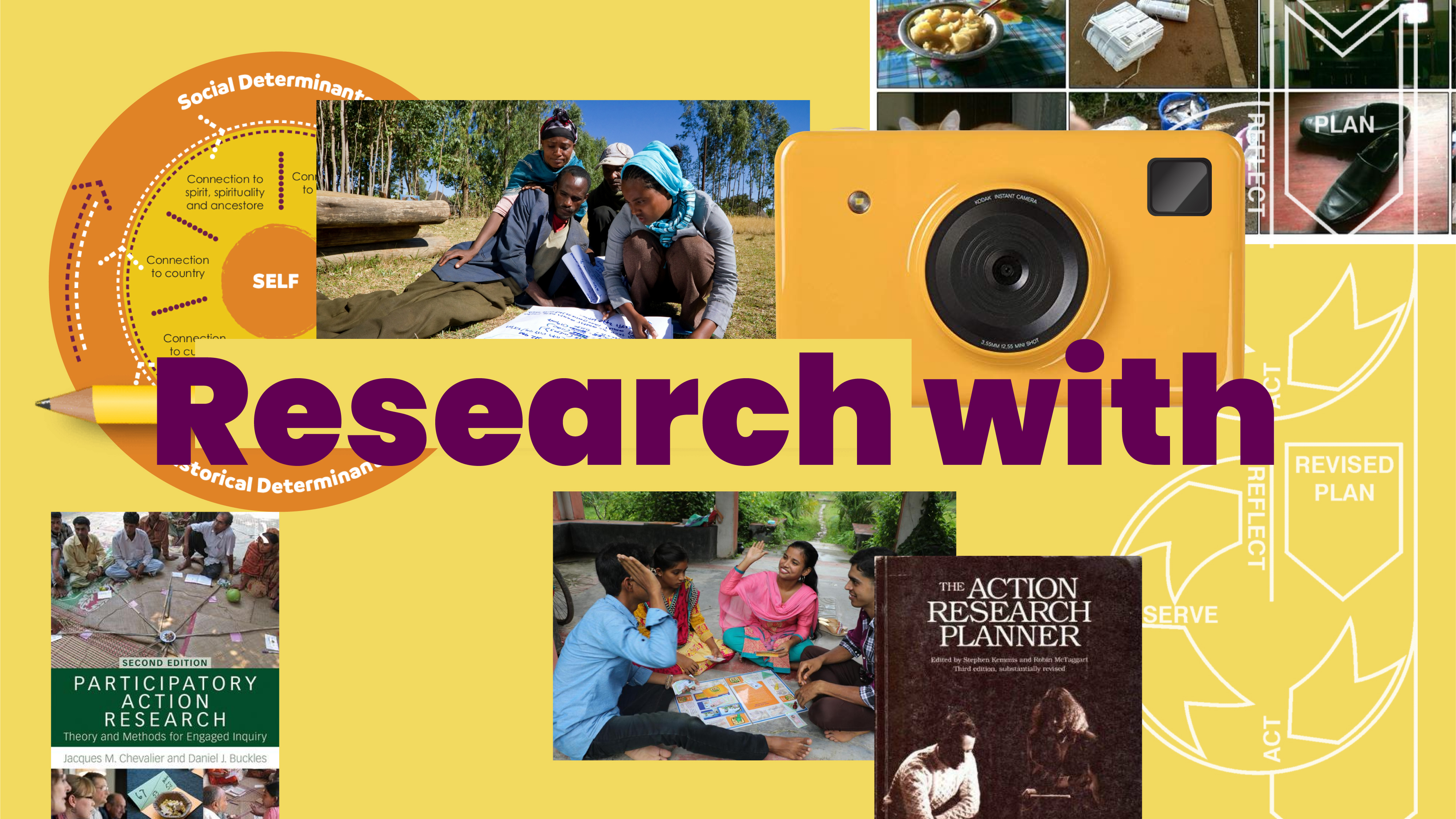
Collaborative inquiry, PAR and social engagement do not come from the world of design, but from sociology, community development, feminist studies and organisational development. They are a series of approaches to research that began emerging in the late 1970’s (at the same time as Scandinavian design) to address the need to evaluate and improve services using grass-roots knowledge.
“Research should be done ‘with’ people and not ‘on’ or ‘for’ them.”
Davydd J. Greenwood and Morten Levin

In collaborative enquiry and PAR, the participant is an equal partner with the researcher. This guiding principle determines how the research is designed and facilitated. “The focus of the inquiry is determined by what the participants consider important, what affects their lives” (Greenwood and Levin, 2013).
Like co-design, they require the active involvement of stakeholders, ranging from program clients, practitioners and community members to funders and managers. Together, they collect knowledge, evaluate systems and create change.

Key concepts, tools and techniques: problem trees, force fields, timelines, gaps and conflicts, VIP (values, interests and position), CLIP (collaboration, legitimacy, interests and power), projection and ideal scenarios, SAS2 and cogenerative research
📖 Read more
- Book Participatory Action Research: Theory and Methods for Engaged Inquiry
- Download The Action Research Planner
- Download When people care enough to act : ABCD in action