
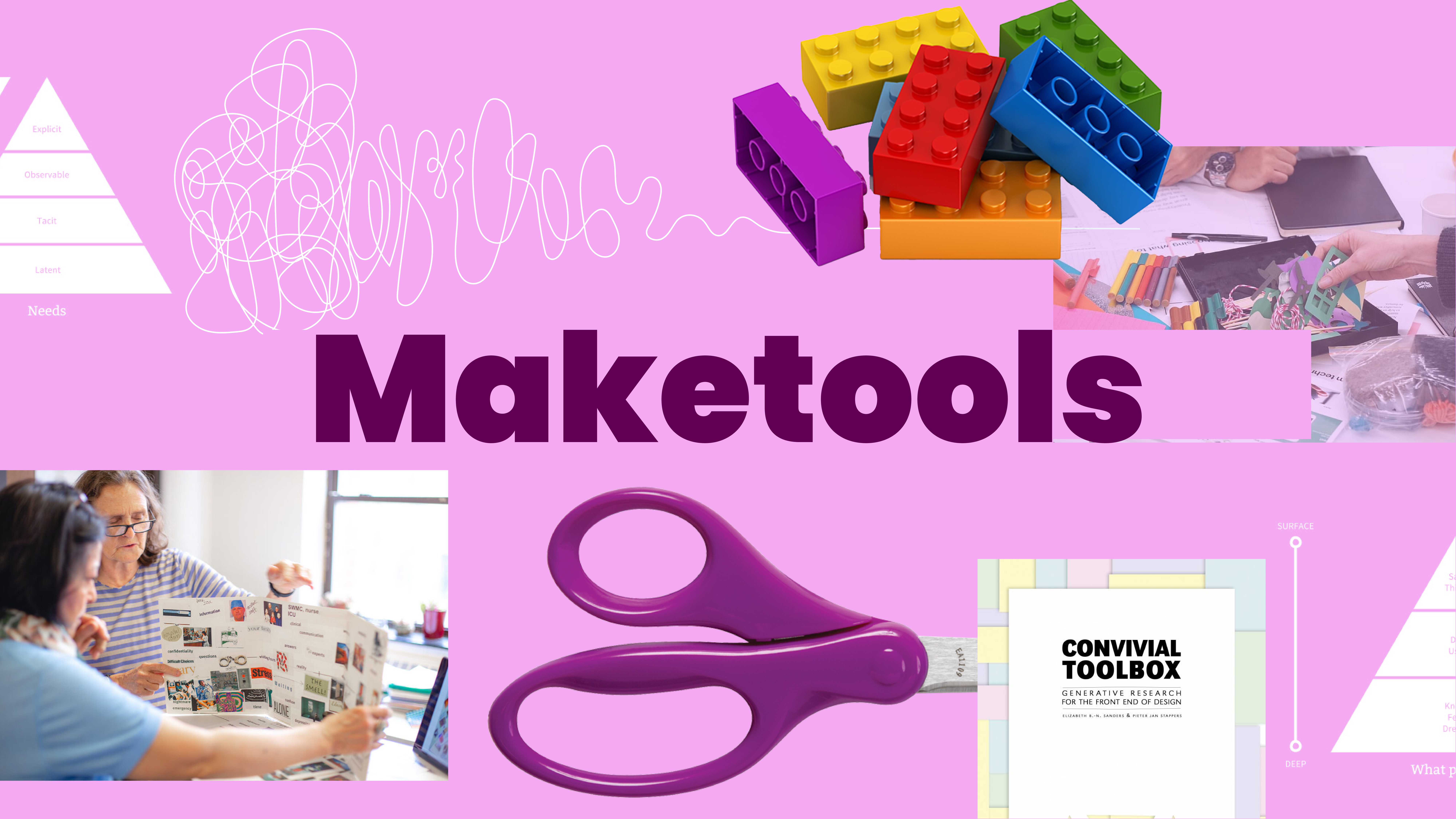
MakeTools are honestly co-design’s secret sauce. Today, maketools typically combine physical objects or digital equivalents that create conditions for a new generative conversation. These generative research techniques spark reflection and ideally (when done well) help anyone – regardless of background or ability – create and communicate experiences or new ideas.
Co-design, design research and action-based research rely heavily on MakeTools to facilitate conversations and capture the thinking processes of participants, it goes back to Participatory Action Research.
What is interesting about MakeTools is that what they are and how well designed they are is not as important as what others can achieve when they create something with them. Using these tools results in design artefacts such as collages, maps, stories, plans, or memories.
Note: Sometimes, especially for designerly folk (myself included) we can end up creating tools that are far too complicated to use; ideally, you want stages of use and for most of the interaction to be fairly intuitive.
“Participatory experience is not simply a method or set of methodologies, it is a mindset and an attitude about people. It is the belief that all people have something to offer to the design process and that they can be both articulate and creative when given appropriate tools with which to express themselves.”
Liz Sanders (2002)


The image above shows three elements of maketools in participatory design (and like co-design, it’s hard to describe). Read more about them in Perspectives on Participatory Design.
In a nutshell, “making” refers to tools and techniques for making tangible things. “Telling” supports verbally oriented activities, including talking and explaining. “Enacting” facilitates acting and playing.

Say
Tools and techniques to support conversations, talking and explaining: Diaries and probes, provocations, cards sorting approaches.
Make
Ways of making tangible things explain how things work today or co-create alternatives: Maps, collages, models, mock-ups and lean prototypes.
Do
Facilitate fun and get a bit weird by acting out ideas: Role playing and improvisation, games, props and simulations to pressure test thinking.
MakeTools were coined by Liz Sanders a practitioner active in the generative and co-creative space since the early 1990’s. She co-authored Convivial Toolbox with Pieter Jan Stappers, a practical how-to guide for anyone interested in generative design research and co-design.
Key concepts, tools and techniques: Collective creativity, ‘Say, Do and MakeTools’, paths of expression, sensitising or priming participants, toolkits and cultural probes, design of trigger sets, service design, photo-elicitation, collage, montage, props, black boxes, scenario-making in the space models, participatory envisioning and enactment, improv, stories and storyboarding , diaries and daily logs, self observation,writing, drawing, blogs, wikis, photos,

📖 Read more
- Convivial Toolbox
- An Introduction to Co-design
- Generative Tools – Stappers & Sanders
- https://maketools.com/
- Generative Design Method Cards
- Perspectives on Participation in Design (2013)